

Carta to Ledgy: Migrating to a European-built equity platform


With Carta sunsetting their European entity and moving customers to its US platform, finance and legal teams across Europe are left asking a simple question: what happens when your equity software isn’t built for your market?
Whether you’re managing Enterprise Management Incentives and Company Share Option Plans in the UK, BSPCE in France, or Virtual Stock Option Plans (VSOP) and growth shares in Germany, you’re operating within distinct legal frameworks. US-first platforms often fail to fully support these schemes natively. The result is manual workarounds, USD-only reporting, and friction that shouldn't exist in an equity management system for European companies.
This article explores why European companies are switching equity management platforms, what Ledgy does differently, and exactly what the migration process from Carta to Ledgy looks like – including timeline and data security.
Why European companies are moving away from Carta
Many European businesses find that US-first equity platforms create unnecessary complexity as they grow. Built around Delaware C-corps and US tax rules, they often struggle to support local frameworks without workarounds. Compliance can become more manual too, with reporting for HMRC, ERS, and Companies House often relying on bolt-on features rather than native functionality.
There are also practical challenges around GDPR, data residency, multi-currency cap tables and multi-entity structures, all of which are standard requirements for many European companies. Add in support teams operating on US hours and platforms that don’t fit naturally into local legal workflows, and it’s easy to see why more companies are choosing equity management software built specifically for Europe.
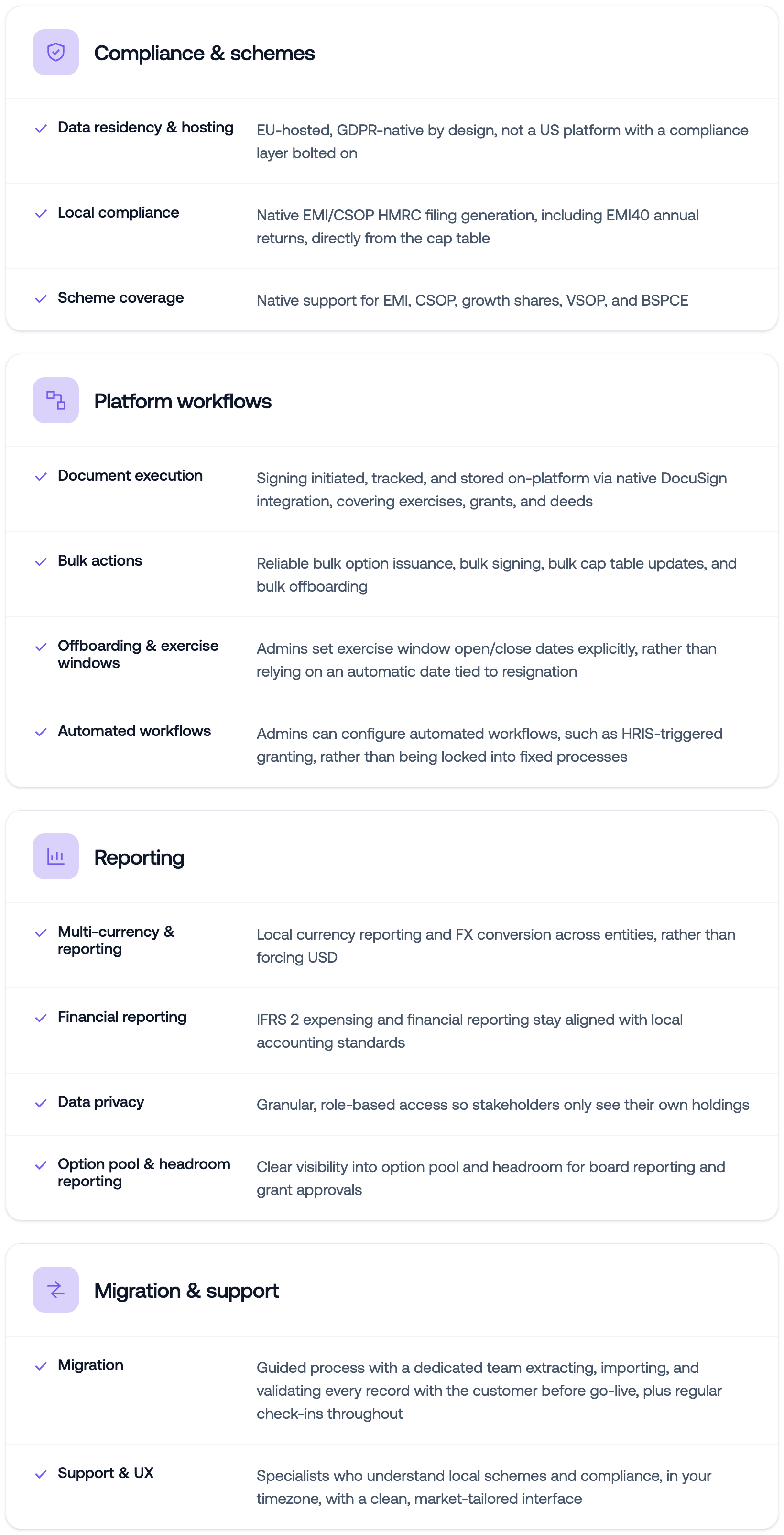
What makes Ledgy different for European equity management
Ledgy is designed natively for European equity management, with local scheme support, EU-hosted data, and workflows built around how European companies actually operate.
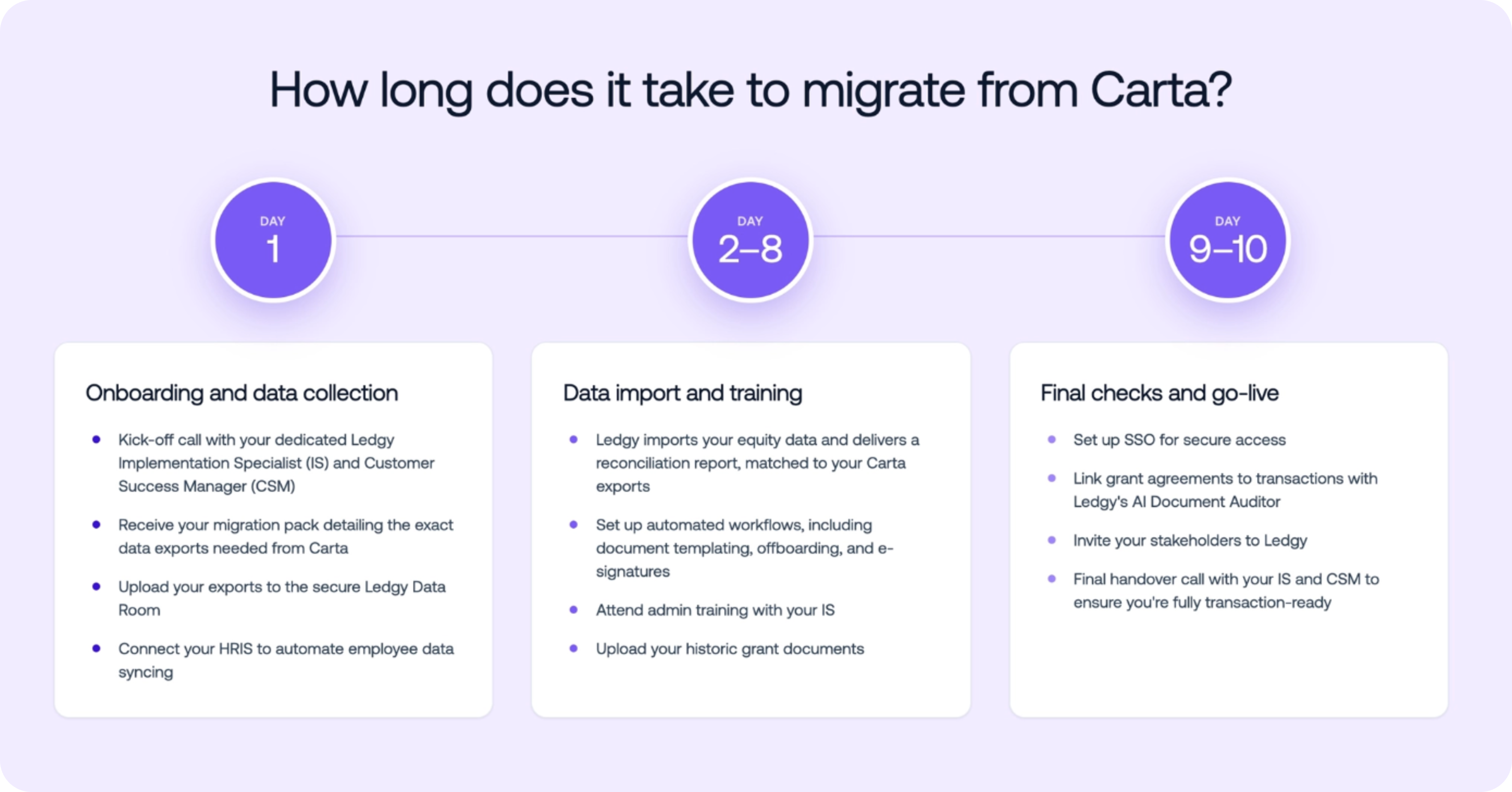
How long does it take to migrate from Carta to Ledgy?
A typical cap table migration from Carta to Ledgy takes 10 days on an Enterprise plan.
It starts with a structured review of your equity setup. A Ledgy specialist reviews your cap table, option holders, and schemes to understand your current structure. This ensures the migration is also an opportunity to identify and resolve inconsistencies early.
From there, your team and Ledgy jointly define the migration plan and timeline. Before any data is moved, all key considerations are documented so you have full visibility of the process.
Ledgy then handles the migration end-to-end, including data import, digitisation of historical documentation, mapping to native Ledgy structures, and full validation before go-live. Once complete, stakeholders are securely invited to the platform.
Secure and complete data migration
When transitioning from Carta, Ledgy’s team handles extraction and migration natively, ensuring a complete and accurate transfer of your historical data.
The migration includes your full, chronological equity history including stakeholder and shareholder records such as names, personal details and employee IDs, cap table data covering share classes, authorised capital and ownership summaries, and equity grants with vesting schedules including complex or custom tranche-based arrangements.
It also includes historical ledgers such as exercise history, settlement records, share issuances, transfers, stock splits, and cancelled or terminated awards alongside all legal documents such as grant agreements, deeds and certificates linked to their relevant transactions.
Even if parts of your cap table currently sit in spreadsheets, Ledgy extracts, imports, and validates every record against your source data before go-live, preserving a complete and auditable history.
A better equity experience for employees and administrators
Moving to Ledgy improves the equity experience for everyone involved.
For employees: Greater clarity and control
Aclearer equity experience: Employees get an intuitive dashboard with a visual overview of their grants, vesting schedule, and estimated equity value- In-platform exercising: Exercise options and complete the signing process within the platform, without external tools or manual coordination
- Localised UX and terminology: The platform reflects how European companies manage equity, rather than US-centric concepts
For employers and administrators: Simplified compliance and reporting
- Built-in compliance: Generate Employment Related Securities and HMRC filings directly from your cap table, reducing manual work and filing errors
- Efficient bulk administration: Issue options, generate documents, and collect signatures at scale with Excel imports and automated workflows
- Native multi-entity reporting: Manage multiple entities and currencies from a single platform, without manual FX conversions
- One source of truth: Keep cap tables, documents, and workflows centralised in a single system
Comparing equity management platforms for European companies
If you're a European company evaluating equity management software, the key questions to ask are:
Local scheme support: Does the platform natively support the equity schemes you use – EMI, CSOP, SAYE, BSPCE, VSOP – or are these handled through workarounds or manual configuration?
Data residency and GDRP: Where is equity data stored? Does the platform meet EU data residency requirements without requiring additional data processing agreements or contractual overlays?
Multi-currency cap table: Can the cap table hold multiple currencies natively, or does the platform default to USD?
Regulatory filing support: Does the platform generate HMRC annual returns, ERS reporting, and Companies House filings natively, or do you need to export data and file manually?
Migration support: Is the migration process fully managed, or does your team bear responsibility for data extraction, import, and validation?
Support hours and team location: Are customer success and support teams available during European business hours?
These are all essential considerations when choosing equity management software. Ledgy is built around these requirements, with native support for European equity schemes, local compliance, multi-currency reporting, and dedicated implementation and customer support across European time zones.
Curious how this plays out in practice? See how companies like Qonto and Neural Concept approached their migration.
When equity gets complex, expert support matters
Managing European equity schemes and growth shares requires specialist knowledge. When deadlines are tight or compliance questions arise, having direct access to knowledgable support can significantly reduce risk and delay.
Ledgy’s Customer Success (CS) team operates across European time zones, with every customer supported by a dedicated Implementation Specialist and CS Manager.
For Deniz Omnus, Group Finance and Transformation Manager at Neural Concept, that expertise helped deliver a Series-C ready cap table in just four weeks, including support for Swiss non-dilutive founder pools that their previous provider couldn’t accommodate.
{{quote-1}}
The same responsiveness proved invaluable during Faculty’s acquisition by Accenture, when Finance Director Jack Stanley needed urgent cap table modelling and guidance.
{{quote-2}}
True equity management requires a time zone-aligned team of experts who can support you when it matters most.
Curious whether switching makes sense for your team? Speak with an expert about your current setup to get a clear view of what migration would involve.

Frequently Asked Questions
Does Ledgy support EMI and CSOP schemes?


Is my equity data GDPR-compliant on Ledgy?
What makes Ledgy different from Carta?
How long does a Carta to Ledgy migration take?
What support is available during and after migration?
Is Ledgy suitable for companies with multiple entities and currencies?

Stay up to date! 🎉
Subscribe to our newsletter and receive the latest insights on the equity world
Cap Table Management Simplified!
Track transactions, model funding scenarios & manage real-time engagement with stakeholders all one platform with Ledgy.
Discover how


